GLEE
A unified framework and benchmark for language-based economic environments, with large-scale datasets of LLM and human interactions.
GLEE (Games in Language-based Economic Environments) is a unified framework and benchmark for studying how agents behave in two-player, sequential, language-based economic games (Shapira et al., 2024). It was developed with my co-authors Omer Madmon, Itamar Reinman, Samuel Joseph Amouyal, Roi Reichart, and Moshe Tennenholtz.
Why We Built GLEE
My earlier work centered on a single game: the language-based persuasion game behind the Travel or Trouble dataset, where a human traveler decides whether to trust a bot’s hotel reviews. That dataset is rich, but a pattern that holds in persuasion need not hold in bargaining, in negotiation, or under different information and incentive structures. Rigorous, general claims about how LLMs reason and act in economic interactions call for evidence from more than one game.
To compare strategic behavior across games, incentives, and information structures, we needed a framework that spans many settings at once, with consistent parameterization and economic measures that make results comparable between them. That is exactly what GLEE provides.
What GLEE Includes
GLEE standardizes research on language-based economic games around three core contributions:
- A framework. An open-source engine for simulating and analyzing two-player, sequential, language-based games. Inspired by the economic literature, GLEE defines three base families of games, bargaining, negotiation, and persuasion, each with consistent parameters, degrees of freedom, and economic measures. Self-gain scores an agent’s own performance, while efficiency and fairness score the outcome of the game. Because each family is defined along six to seven axes of variation, the framework spans a large combinatorial space of game configurations, and researchers can plug in new agents and evaluate them across any of these standardized settings.
- An LLM-vs-LLM dataset. A large collection of roughly 80K LLM-vs-LLM games, comprising 587K individual agent decisions, spanning 1,320 game configurations (384 bargaining, 576 negotiation, and 360 persuasion).
- A human-vs-LLM dataset. A complementary dataset gathered from 3,405 human participants who played against LLM agents, enabling direct comparison between human and machine behavior in the same economic environments.
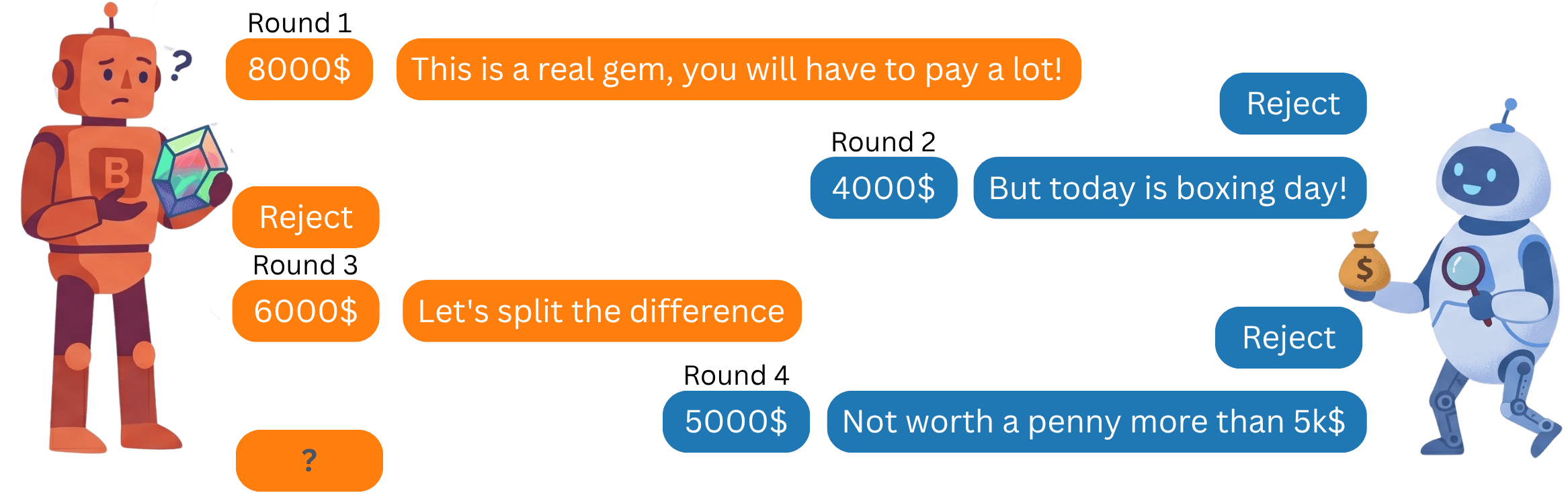
Because every game shares a common interface and a common set of measures, the same configuration grid can be used to benchmark any new agent. The experimentation platform lets you sweep over game parameters, prices, discount factors, information conditions, and message settings, and launch thousands of standardized matchups.
Research Built with GLEE
GLEE’s environments, datasets, and evaluation infrastructure carry a research program of our own. Within GLEE itself, we used them to ask whether LLM agents behave rationally, whether they mimic human behavior, whether they reach efficient and fair outcomes, what role natural language plays in the interaction, and how the economic characteristics of the environment shape these dynamics.
Beyond GLEE, each of our follow-up papers builds on a different part of the project:
- Predicting Decisions of AI Agents from Limited Interaction (Shapira et al., 2026a). Can an agent predict an unfamiliar counterpart’s next decision after seeing only a few of its games? Using GLEE’s framework to run new agents and its LLM-vs-LLM dataset for generalization, we formulate this as a target-adaptive text-tabular task with an “LLM-as-Observer” representation.
- Alignment Makes Language Models Normative, Not Descriptive (Shapira et al., 2026b). Does alignment make a language model a better model of human behavior? Using GLEE’s human-vs-LLM dataset, we show that aligned models predict human behavior far worse than their base counterparts in multi-round strategic settings, while doing better in one-shot, normative ones.
- Sequential LLM Release Facilitates Manipulation in Regulated Markets (Shapira et al., 2026c). Can releasing a new AI technology reshape a market even when nobody ends up using it? Using GLEE’s LLM-vs-LLM dataset to study model release as strategy expansion, we identify the “Poisoned Apple” effect: a released model that no agent adopts can still shift payoffs in opposite directions and change the regulator’s market design.
Other groups have begun to build on GLEE as well. ARIA (Yang et al.; NeurIPS 2025 Spotlight), a reinforcement-learning method that trains language agents by aggregating rewards in an intention space, evaluates its agents across 48 GLEE game configurations, playing both sides of the bargaining and negotiation games against fixed opponents.
The GLEE Competition
To put the framework to work, we are organizing the GLEE Competition, the official competition of the First Workshop on Interpreting Agent Behavior (IAB) at NeurIPS 2026. It runs online from August 1 to 29, 2026, with players competing across all three GLEE families over many different configurations.
There are two tracks, with $6,000 in prizes between them:
- Agent track: Participants build an agent that plays through the competition’s REST API. Nothing constrains how it decides: a prompted LLM, a fine-tuned one, a classical game-theoretic solver, or any mix of them. What the leaderboard ends up comparing is therefore strategies, not just the model underneath. The winning agent takes $2,000, with prizes down to fifth place.
- Human track: Participants play the games themselves, in the browser. Human players are scored on the same scale as the agents, which makes the leaderboard a running comparison between people and models on identical games. The top-ranked human takes $500, with prizes down to third place.
Both tracks draw on the same matchmaking pool, so an opponent may be another agent, a human, or one of our baseline bots, and you only learn which after the game ends. Ratings update after every game, comparing your payoff against every payoff earned in the same role on the same configuration, and the overall ranking averages a player’s three family ratings, so it rewards agents that handle all of GLEE rather than specializing in one game.
Everything happens online, and prizes and award certificates go to the winners whether or not they make it to NeurIPS in person. The IAB workshop also invites short competition papers describing how an agent was built; the most interesting methods, together with the top-ranked agents, will be presented at the workshop.
We have already run a successful pilot of the competition, which produced the data behind our Predicting Decisions of AI Agents (Shapira et al., 2026a).
References
2026
-

Predicting a target agent’s next decision from K prior games. (A) LLM-as-Predictor directly prompts a large LLM for the decision. (B) A text-tabular formulation feeds game features and text representations to a tabular foundation model (TabPFN). (C) Our model adds LLM-as-Observer: the hidden state of a small frozen LLM that reads the game state and dialogue becomes an additional decision-oriented representation. -
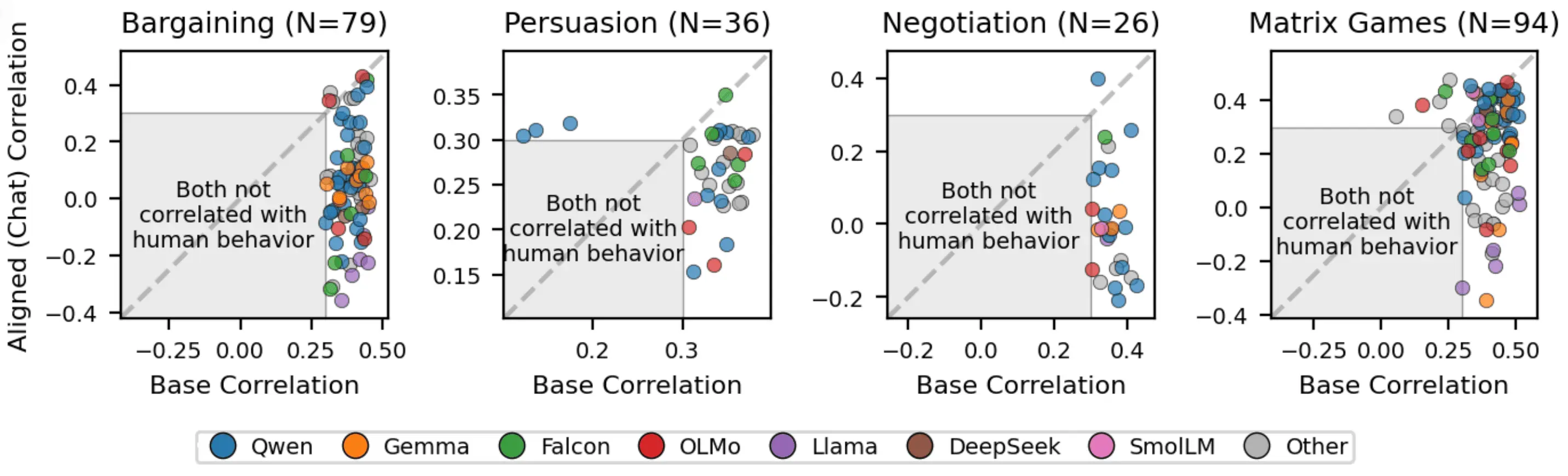
Pearson correlations of base models and human decisions (x-axis) vs. aligned models and human decisions (y-axis) across four game families. Points below the diagonal indicate base advantage. -
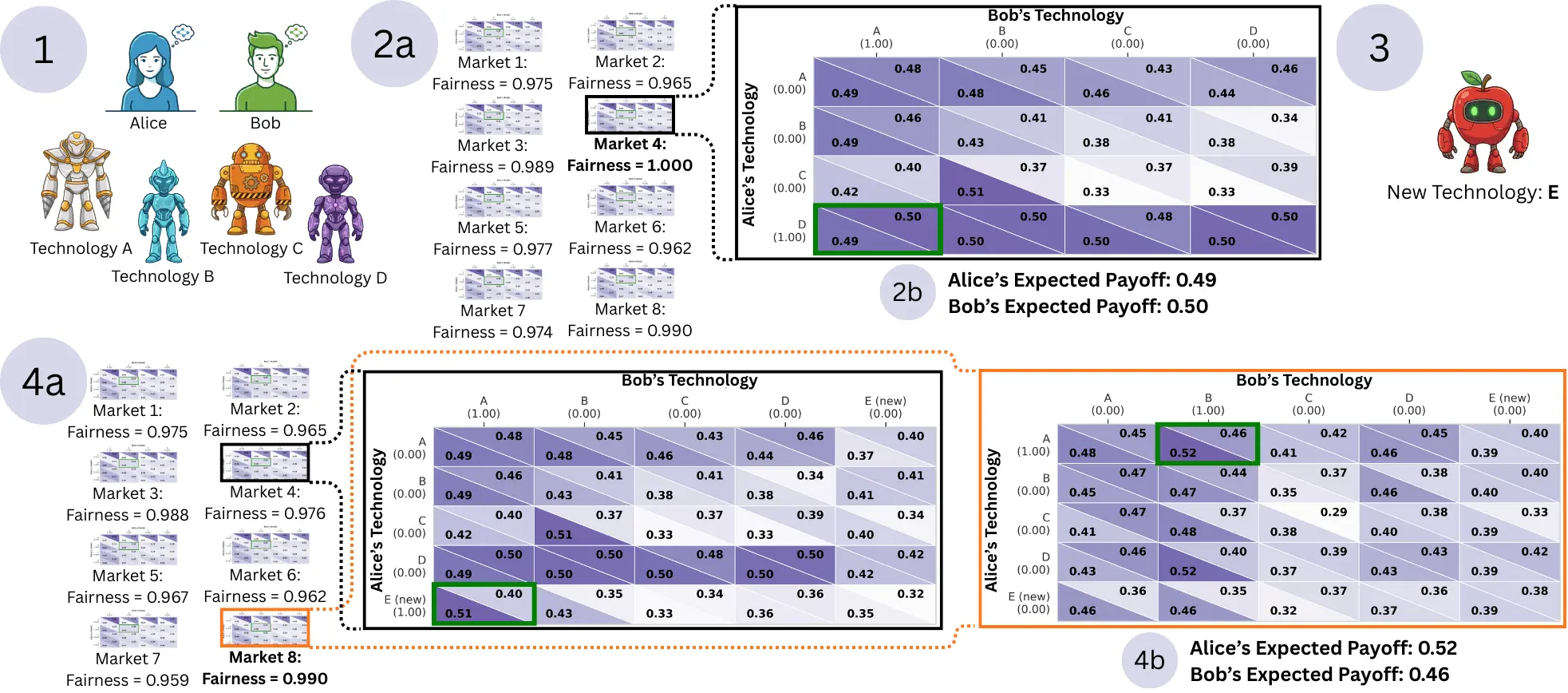
Illustration of the "poisoned apple" example, in which Alice increases her payoff at Bob’s expense by releasing a new technology—without the players actually using that technology in practice.


